


I originally thought I’d write one article about how I learned to teach students to understand and conceptualize their truly unique thinking, helping them communicate with people who think so differently it causes problems in their lives.
That article grew into an unwieldy monstrosity of ideas.
So I’m breaking it into chunks and sharing it with you here.
The theory I’ll present, which I feel is deeply and profoundly supported by research, has grown out of my rather unusual and unconventional experience in education. My experience as a neurologically unique student who, despite the labels, stigmas, and social forces, became a teacher myself. It is a story of becoming, which is part of everyones experiance… Even if you don’t notice. But when you start to it becomes you.

Building Classrooms for the “Unteachables”
I’ve spent most of my career building and working in specialized classrooms for students who would have been denied a public education at an earlier time in American history. I was fortunate to have come into education when resources were relatively plentiful, and the district I worked in was committed to the program’s success.
I was afforded the luxury to develop my teaching craft in the sincerest of ways. At the time, the people I was working with had hardly any more knowledge about how to approach these complex students than I did. However, they had the wisdom to see that wasn’t a weakness. It was a problem to solve, and that meant it was an opportunity to discover and grow something that works.
Not only was I given an unprecedented opportunity to develop specialized ways of working with students whose behavior impacted not only their learning but the learning of others around them. I was supported and encouraged to use my knowledge and creativity to address problems that very few other people in the district had experience with.
And I was uniquely suited for this job.
Because while I had told no one—with the exception of my students—I had actually spent my entire childhood being educated in a very similar kind of special education program. Living with, befriending, and basically growing up with the same kinds of students I was now teaching.
These were students like myself. Students with unique profiles that didn’t fit cleanly into any diagnosis. More significantly, they didn’t conform to the usual classroom interventions offered in weekend professional development courses.
My First Disaster: High School
There’s no substitute for experience. But there’s something particularly important about having experiences of success…particularly pulling success from the jaws of disaster.
My first experience of this was when I had so completely failed high school that they couldn’t justify doing what they’d been doing before: moving me down an academic level or into a special education classroom and passing me on through what was called back in the day “Social Promotion.” Now they were talking about putting me into a full-time vocational program, but still passing me on to the next grade.
Instead, my dad demanded that I be held back and that they put me in all college prep classes, he said, where I could—and I quote— “fail some classes that actually meant something.”
And that’s what they did.
But my parents also got me a mentor who was teaching in what was then a relatively new program called PAL—the Program for the Advancement in Learning at Curry College. It was founded by a woman named Gertrude Webb, whose accomplishments I’ve written about before.
It was through this mentorship in metacognitive understanding that I was able to discover a way to get myself into college. This involved me taking courses through the college’s center for lifelong learning while I was still struggling to graduate high school. By this time I was now in all college prep classes and not putting up great grades.
However, Dr. Webb and Curry College took me on after graduation. And using the metacognitive approach to my learning they introduced to me, I was ultimately able to graduate with a double major and distinctions in the Alexander Graham Bell Honor Society. From this failure sprang some of my most significant successes.

The Program for Advancement of Learning, Curry College.
My Second Disaster: The Classroom
By the time I graduated and got my first job, not only had I experienced pulling success from the jaws of disaster, but I was determined to figure out how I did it. The job I’d worked my way into provided an unprecedented opportunity to work toward that. Dr. Webb’s metacognitive approach grounded my work in a way that was different from what other special educators were doing, and I was having success. This success prepared me for when disaster raised its head again.
This time it was budget cuts and paperwork eating into actual classroom time. My program, originally designed to be a small group for 6-7 students, so-called rare student types grew to 10, then 13, then 16 students. It should have collapsed under that weight.
Instead, I developed Wholistic Problem Solving, a metacognitive approach that teaches students to investigate and self-define their learning, then use that knowledge to guide and inform their behavior and approach to the problems in their life.
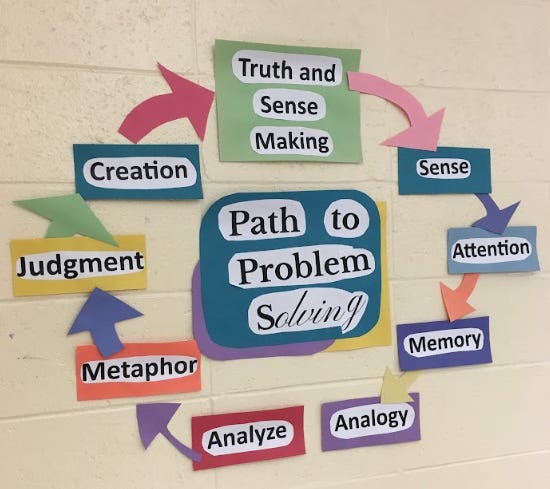
One of the early manifestations of the program, before I settled on Wholistic Problem Solving as the name.
A Crisis in Education (And Why There’s Hope)
As I look at the long and continuing crisis in American education, I worry that fewer new teachers are having the opportunity to experience the kind of hope-inducing success I was privileged to have. Sadly, the profession is more devalued and downtrodden than ever.
I share my story because I feel there’s something empowering that other neurologically unique people can draw from it. It’s a lesson that should resonate for both students and teachers, because both are often engaged in the business of snatching success from the jaws of defeat. Learning is like that.
But my experience also says something profound about BEING a teacher. There’s something qualitatively different about teaching that gets lost when we don’t allow learning to develop through problem-solving.
Learning is a problem-solving interaction that everyone does differently, and everyone can learn to do it better. And everyone benefits from the support of another person who can relate to their difference, even if it’s not their own difference.
This is what I learned as a teacher when budgets were slashed and demands increased to eclipse other critical parts of the job. In those desperate conditions, I created a system of self-investigation and self-development. One that was committed to producing an approach that educated all students to become independent self-authors of their own lives.
Today, things are looking pretty desperate in the field of education. The jaws of destruction are looking to end that free metacognitive problem-solving approach that has brought me here.
So it is fitting that this is where my educational movement starts.
If you have already joined by becoming a subscriber, I thank you its your support that is presently giving me the hope to continue with this mission.
If you are new, please consider subscribing, following or sharing. Educational movements are started and sustained by involvement, and your involvement would be greatly appreciated.
Finally, I am looking to start doing more live streams here on Substack, and one I would love to do would be like a reunion of all my former students and co workers. So if you are reading this and you are a former student, reach out and I will send you the private link for the event. If you are a subscriber, you will also receive an invite. I think it will be pretty cool to get together to share stories and reconnect. So if you are interested in attending, shoot me a message, or just subscribe.